StarkZuri V2: Account Abstraction & Zero-Gas Prediction Markets on Starknet Mainnet
"A deep dive into how we re-engineered StarkZuri V2 to eliminate wallet friction using Starknet SNIP-9 paymasters and embedded passkeys."
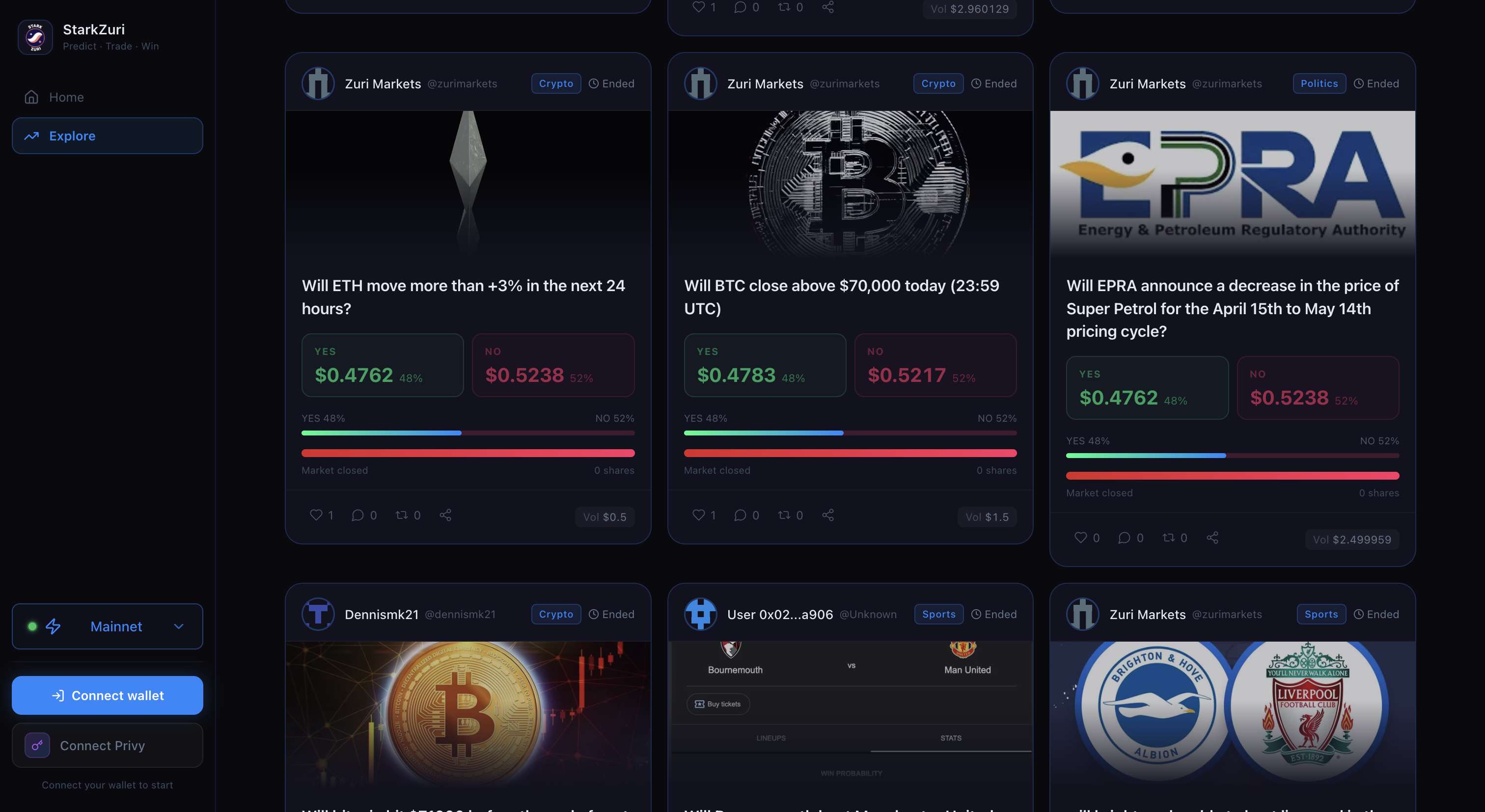
- ↳Sponsored Zero-Gas Execution via AVNU Paymaster (SNIP-9 outside execution)
- ↳Passkey and embedded wallet sign-in with Privy
- ↳Sub-second optimistic UI states backed by L2 state proofs
- ↳Over 12,000 predictions settled without a single user paying gas directly
Prediction markets have historically suffered from an insurmountable UX hurdle: onboarding non-crypto natives requires funding a wallet, acquiring gas tokens, and signing cryptic hex payloads. With StarkZuri V2 on Starknet Mainnet, we set out to prove that decentralized verification can feel as frictionless as Web2 social platforms.
The Architecture of Invisible Gas
In StarkZuri V1, users still had to manage small balances of ETH or STRK for state verification. While Starknet L2 gas is pennies, any non-zero requirement creates a barrier to entry. For V2, we re-architected our smart contracts to support SNIP-9 meta-transactions.
Instead of sending an invoke transaction directly from the user's account contract, the client signs a typed off-chain commitment. Our relayer verifies the signature, appends an AVNU paymaster token, and executes the call bundle via a single multicall batch.
#[starknet::interface]
pub trait IPredictionMarket<TContractState> {
    fn execute_sponsored_position(
        ref self: TContractState,
        market_id: u64,
        outcome_idx: u8,
        stake_amount: u256,
        user_signature: Array<felt252>
    ) -> bool;
}Native Cairo 2.0 Optimizations
Rewriting our matching engine in Cairo 2.x allowed us to optimize step counts and data packing. Order states and pool liquidity shares are packed into tightly bounded bit ranges, reducing storage writes by 42%.
This efficiency translates directly to lower relayer overhead, making continuous zero-gas sponsorship sustainable across thousands of active concurrent participants.
"The most impactful crypto applications are the ones where users forget they are interacting with a distributed state machine at all."
What's Next on the Mainnet Roadmap
With V2 live on Starknet Mainnet, we are expanding resolution feeds to support decentralized oracle consensus, alongside cross-community reputation badges for top predictive analysts.
Founder and systems engineer at Felabs Studio, architecting decentralized protocols, autonomous AI tooling, and high-craft digital interfaces.
Related Dispatches
Building StudRush to $10k MRR: Seeking 2 Founding Partners
We are building StudRush, an AI-powered exam triage engine for students, and scaling it to $10k MRR. We are seeking 2 founding partners: one for Growth & Community, and one for Product, with equal equity and transparent vesting.
TaskBridge: Building Browser-Native Tooling for Autonomous AI Agents
How we engineered TaskBridge for the OpenAI WebMCP Challenge to create a dual-interface workspace where human operators and LLM agents collaborate.