TaskBridge: Building Browser-Native Tooling for Autonomous AI Agents
"How we engineered TaskBridge for the OpenAI WebMCP Challenge to create a dual-interface workspace where human operators and LLM agents collaborate."
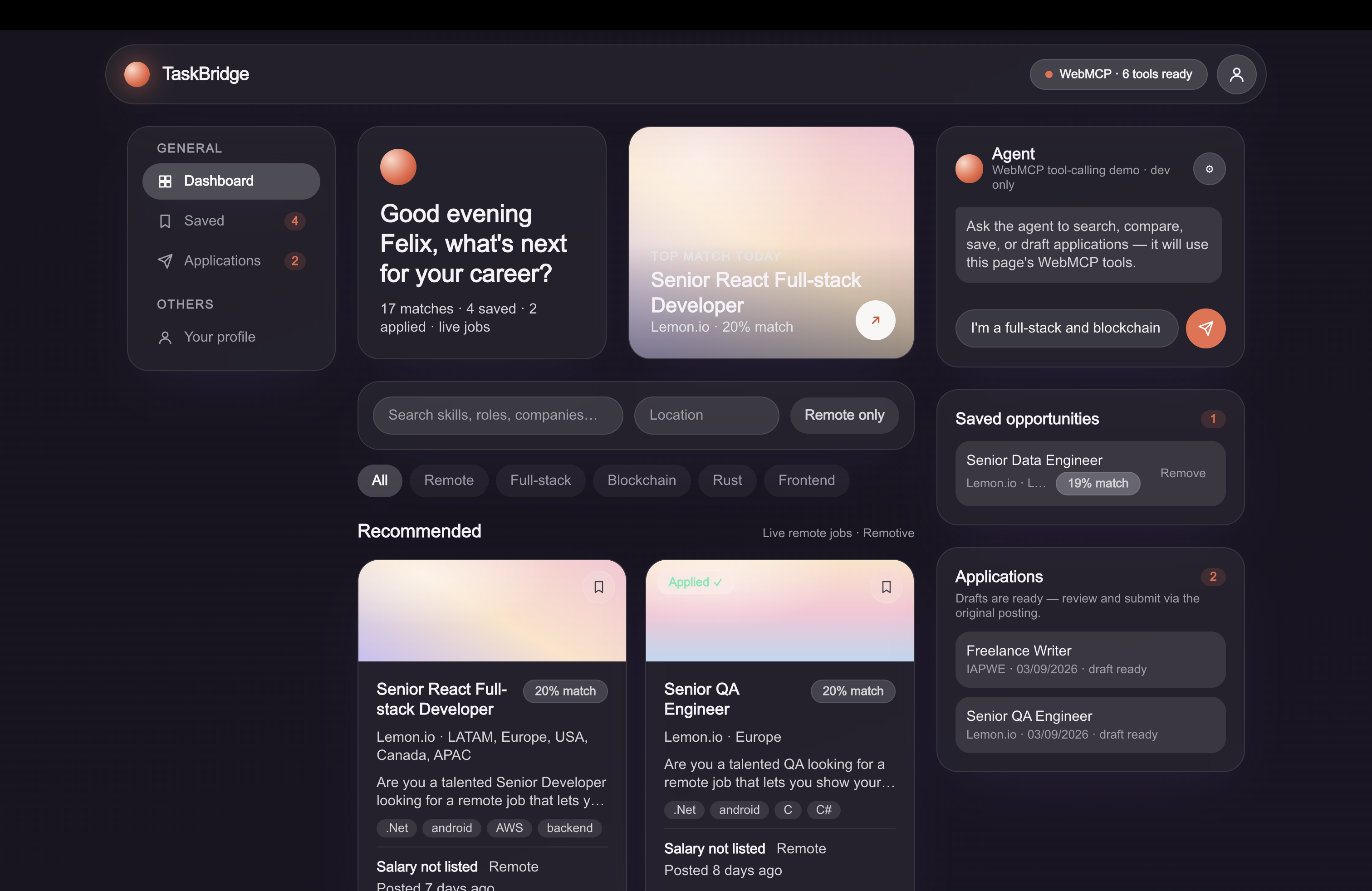
- ↳Bilateral protocol bridging web DOM contexts to remote MCP agent sessions
- ↳Deterministic sandboxed execution of agent actions with human approval checkpoints
- ↳Zero-latency streaming UI with real-time tool telemetry
The Model Context Protocol (MCP) transformed how local applications provide context to AI models. But web-native workflows remained siloed. When OpenAI announced the WebMCP Challenge, our studio built TaskBridge: a collaborative canvas exposing browser-native agent tools directly over standard protocols.
The Challenge of Client-Side Tooling
Traditional MCP servers run as standalone daemons on the host machine. In a web browser environment, security sandboxes prevent arbitrary process spawning. TaskBridge circumvents this by implementing an in-browser MCP proxy.
Client state, DOM mutations, and scheduled task queues are serialized into standardized tool definitions that LLMs can query and invoke deterministically.
export const taskTools = [
  {
    name: "inspect_workspace",
    description: "Inspects the active job canvas state and pending tasks",
    inputSchema: { type: "object", properties: { workspaceId: { type: "string" } } }
  },
  {
    name: "dispatch_job_batch",
    description: "Executes structured steps on behalf of the human operator",
    inputSchema: { type: "object", properties: { steps: { type: "array" } } }
  }
];Human-in-the-Loop Safeguards
Autonomy without oversight inevitably leads to catastrophic drift. In TaskBridge, every high-impact tool invocation requires an explicit cryptographic authorization signature from the human operator.
The result is a workspace that feels like pairing with an exceptionally fast junior engineer who never acts rashly on irreversible actions.
Founder and systems engineer at Felabs Studio, architecting decentralized protocols, autonomous AI tooling, and high-craft digital interfaces.
Related Dispatches
Building StudRush to $10k MRR: Seeking 2 Founding Partners
We are building StudRush, an AI-powered exam triage engine for students, and scaling it to $10k MRR. We are seeking 2 founding partners: one for Growth & Community, and one for Product, with equal equity and transparent vesting.
StarkZuri V2: Account Abstraction & Zero-Gas Prediction Markets on Starknet Mainnet
A deep dive into how we re-engineered StarkZuri V2 to eliminate wallet friction using Starknet SNIP-9 paymasters and embedded passkeys.